

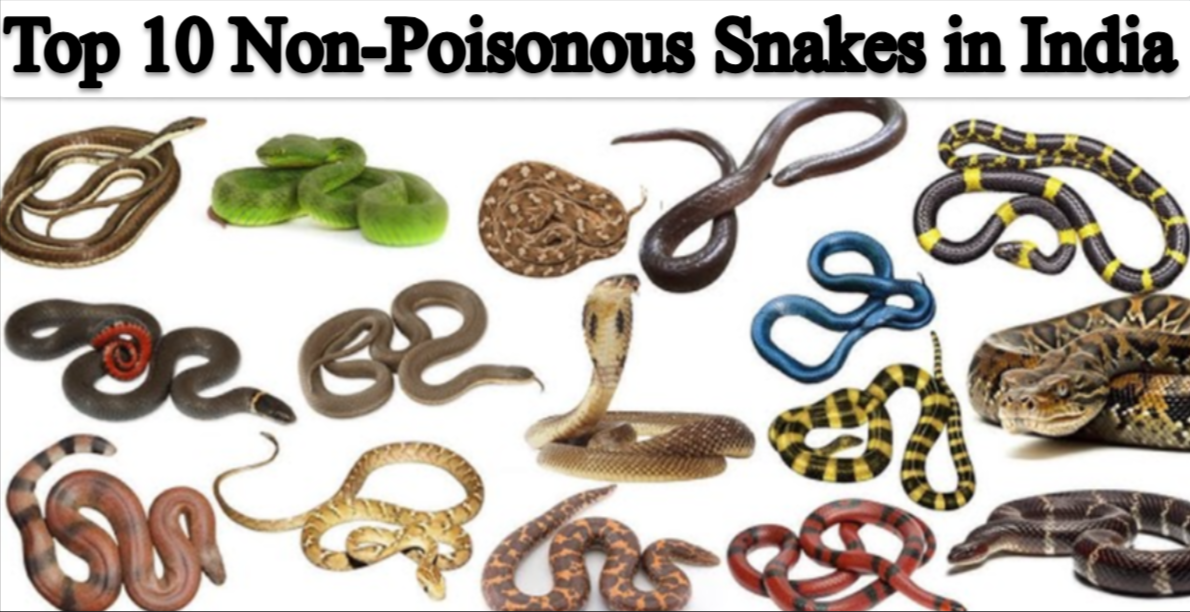
You’ll be shocked by the fact that there’s lots of people who believe that all snake is poisonous or poisonous. If you’ve learned the basics of the world of wildlife and all that you’ll realize it’s not the way things work or are usually. India is one country in which the wildlife is quite diverse actually, and that’s the case with snake species too. There are more than 350 species of snakes in India And, of course that not every species of snake is poisonous. This time, however, we’re to take a close look at the top 10 poisonous snakes that are found in India. If that’s something that you’re interested in right now, continue to read.
Top 10 Non-Poisonous Snakes Found in India
1. Indian Rat Snake (Ptyas mucosa)
It’s true that it is true that the Indian Rat Snake is one of the snakes with the fastest speed that belong to India Did you know this? As such, Dhaman is the common name used for this species. The snake can grow to 6-8 feet in length and is among the biggest snakes without venom that is found across the nation. The snake is found in the areas that have agricultural land, as well as urban areas. It’s an important element of pest control. It feeds on frogs, rats and other small birds, for the sake of being clear. Indian Rat Snake Indian Rat Snake has a large and intimidating appearance and neck-flattening behaviors when threatened as the cobra, yet totally non-threatening.
2. A Checkered Keelback (Xenochrophis piscator)
Maybe you’ve walked through a river or lake and saw an aquatic snake floating effortlessly over the water. It’s most likely known as the Checkered Keelback. The reason is that, called”the” Indian Water Snake, this species is an excellent swimmer and spends a lot of its time in freshwater. The distinctive checkered pattern that it has that is in stark contrast to the surrounding has made it well-known. As a safeguard it could make a noise or bite if it is it’s disturbed, but as it’s totally harmless. Keep this in your mind.
3. Indian Rock Python (Python molurus)
It’s the Ajgar snake in this case, which is commonly referred to by the name of Indian Rock Python and just to be clear it’s actually the biggest non-poisonous snake species in India. It can weigh as much as 10, if not more and from a distance, one may think that it is armed with a ferocious bite something, but in the depths one can see that it’s an extremely slow-moving, non-aggressive reptile. Instead of utilizing the venom of a snake, it is able to constrict its prey, which ranges from birds, rodents to deer by brutal force.
4. Common Sand Boa (Eryx Johnii)
In the 4th place, you will notice an interesting aspect about this species is that the common sand boa is thought that it has two heads! This is due to the body’s short and strong and a nearly oval tail that closely resembles its head. This gives them the name of”a “two-headed snake” as you may have guessed. As such, it is an living in dry and barren regions. Being burrowing snakes and a burrowing snake, it is most likely to spend its time in the underground, hunting rodents and small lizards which is all.
5. Common Wolf Snake (Lycodon aulicus)
It is true that for newbies the name may scare you However, the snake referred to by its name Common Wolf merely managed to sneak into human settlements. With a length of 3 feet, people often mistake it for the deadly Common Krait due to its banding, but what do you know? In its natural state, it is not night-time. It hunts small lizards and frogs which is why it is a great choice to control pests.
6. A Banded Racing (Argyrogena fasciolata)
You will realize that the The Banded Racer can be described as a serpent that moves around either as adept at navigating the grass or being extremely fast. It can grow to a length that can reach 4 feet. The slim snake favors areas with high bushes, as it swiftly is seen scurrying around to prey on rodents and frogs. This is the way it behaves at night in wild. To be clear that this snake isn’t hazardous, regardless of what it looks like, as in the sense of its erratic movements and striking appearance.
7. Common Trinket Snake (Coelognathus helena)
Yes, as gorgeous as its name implies, this Common Trinket Snake is the most beautiful snake on this list right now. The shiny scales contribute to its trinket-like appearance. This is what makes it among the top stunning snakes that we have on our list, for sure. This species of snake that is not poisonous reaches the size of four feet in length and eats rodents, lizards and small mammals, making it a very effective pest-control agent in the agricultural zones.
8. Brahminy, the Blind Snake (Indotyphlops braminus)
You will realize that this is a snake you may have seen, but not recognize as an earthworm. It’s it’s the Brahminy The Blind Snake. You’ve seen it? It’s non-toxic snake measured at between 6 and 8 inches. It is the smallest in India. It is found in the underground and humid, in dirty garden, ground and fields, consuming on termites, ants and other tiny insects. And the good news is that it’s non-toxic at all.
9. Bronzeback Tree Snake (Dendrelaphis tristis)
One of my friends once said “If speed has faces, then it’s the face of the Bronzeback Tree Snake.” Did they get it right? Let’s take a look the snake’s face. It is most famous for its the speed at which it ascends and is seen hopping across the tops of trees or through thick bush. It has a maximum length of about 4 feet. The slim body, along with a sparkling bronze stripe on its back is a striking appearance, for sure.
10. Striped Keelback (Amphiesma stolatum)
On the last list, lastly, we have the striped Keelback One shy snake, a common appearance in wetlands and grasslands like wetlands, right? The maximum length is 3 feet. dimensions, this serpent had two stripes of yellow on its olive-green body. Remember, however, that it is not uncommon for it to flatten its body to avoid danger, but this snake isn’t dangerous and will be more afraid of you than you’d ever be.
Conclusion
Here you go. Absolutely, there are many other non-poisonous snakes found in India however, keep in mind that these are the most prevalent. If one of the snakes bit someone, you’re aware that they’re secure, there’s no reason to be concerned.