

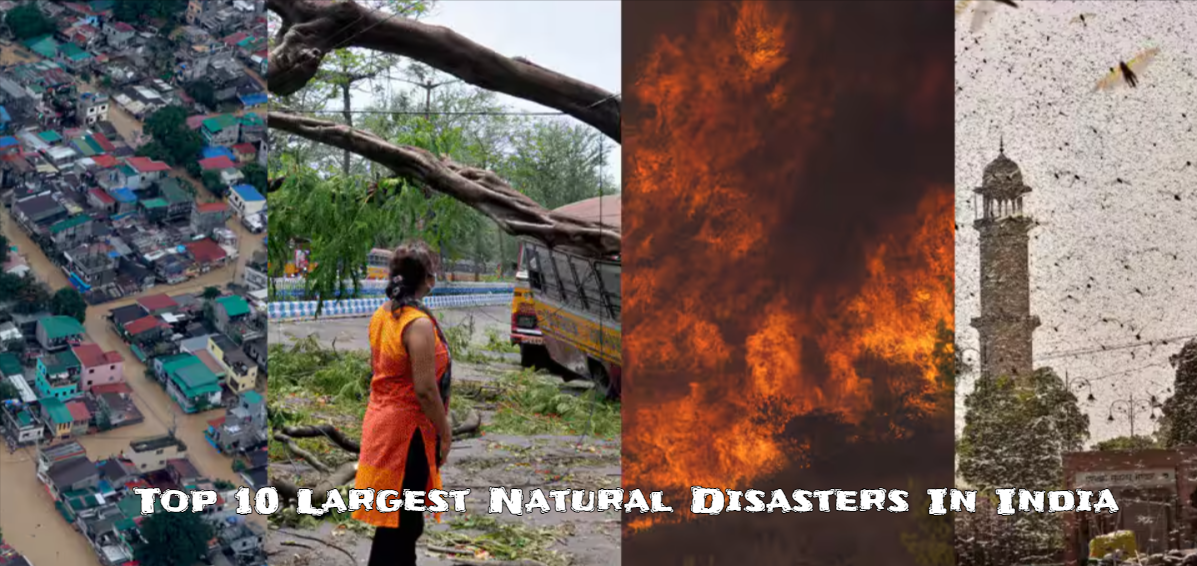
Most of the time natural disasters aren’t something we can anticipate and aren’t able to be able to avoid completely. They can happen from time moment, and that’s when we are able to understand the power of nature or may be in some cases. The past has seen numerous natural disasters have claimed many millions people across the globe. any time a natural disaster occurs it’s a major loss for humanity. This time, however, we’re here specifically to take an thorough look at the 10 largest natural disasters to hit India ever. To be honest, India has been through some of the most destructive natural disasters that exist. So, let’s take an overview.
Top 10 Largest Natural Disasters In India
1. The Great Bengal Famine (1770)
This was the most devastating event in Indian history, and many people felt it as a doomsday event, and, yes, you’re correct, we’re talking about the Great Bengal Famine of 1770. For the sake of clarity that the famine wasn’t solely caused by dry and erratic monsoons. the agony was further exacerbated by the oppressive policies of the East India Company and that was a major issue at the time. For a better understanding on the issue, more than 10 million women, men and children fell to the ravages of hunger and a myriad of diseases throughout Bengal, Bihar, and Odisha.
2. Coringa Cyclone (1839)
The next item on the list is did you have any idea that Coringa was once a thriving port city located in Andhra Pradesh, could be almost completely erased from history because of a single event? Yes, you’re correct that the cause was a storm that hit the city in 1839, causing the storm surge that was so strong that it killed over 20,000 and completely destroyed the city. Then, Coringa never looked the identical, and probably never will.
3. The Plague Epidemic (1894)
An outbreak can cause damage to an entire country, and that’s not less than a natural catastrophe The plague epidemic of 1894 demonstrated that point in the most tragic way. It took the form of a wildfire in this overcrowded region of cities such as Bombay and Calcutta and claiming 12 million deaths across India. In the past in the past, inadequate sanitation and a lack of medical infrastructure made it impossible to contain the outbreak making this one of the most deadly epidemics during Indian history.
4. Odisha Super Cyclone (1999)
It’s 100% fact it was the Odisha Super Cyclone, perhaps the most destructive of India’s cyclones in past, did occur and was the most destructive so far. For a better understanding about the events the winds were traveling at over 250 kilometers per hour (155 miles/hour) that is equivalent to an extreme Category 5 storm that’s right, leading to the deaths of 15,000 people as well as the displacement of many millions. It’s not just that it was a huge economic loss, exceeding $4.5 billion. This natural catastrophe has caused India to be proactive in addressing the issue of disaster preparedness and cyclone warning systems. Those systems have advanced to an advanced condition over the course of time.
5. Gujarat Earthquake (2001)
It was Republic Day of 2001 was the beginning of the darkest hours of Gujarat. As it was back then the 7.7 Richter scale earthquake resulted in the deaths of more than 20,000 and a large number were injured. A few cities like Bhuj and Ahmedabad came out as the worst affected by the economic loss of more than $5 billion.
6. Indian Ocean Tsunami (2004)
It was day 26 of 26th 2004 a massive earthquake with a magnitude of 9.1 hit the sea and a devastating tsunami struck across the entire area of the Indian Ocean. Be aware that in India the effect of the tsunami was felt throughout areas like Tamil Nadu, Kerala, Andhra Pradesh, and the Andaman and Nicobar Islands, an island group. More than 12,400 people lost their lives and thousands of people were left homeless and sought shelter in camps for relief or with other families. This certainly led to India in the process of developing an accurate and more effective tsunami warning system that is in place in a number of different locations.
7. Mumbai Floods (2005)
Imagine an urban area like Mumbai being brought to an end due to the never-ending rain was the case on the 26th of July the 26th of July, 2005. What was the reason? Just to let you be aware, the city saw an incredible 944 millimeters of rain in 24 hours, causing to block drainage systems and consequently coordinating with the onset of severe flooding. About 5000 people were killed in the capital city, and the financial center was without infrastructure move, which was quite a major issue to behold.
8. Uttarakhand Flash Floods (2013)
We’re all aware at this point that the year 2013, we witnessed the rage of nature unleashing its force on the Himalayan state of Uttarakhand. The glacial lake eruptions that flooded the rainy conditions, caused devastating flash floods of 2013. The flooding occurred in the area that is home to Kedarnath temple. There, over 5700 people died as well as countless houses bridges, roads, and roads getting swept away, know?
9. Kerala Floods (2018)
Then, the month of August in 2018 was expected to be the final month to see Kerala suffer the biggest flooding event in more than 100 years. As with the other areas, they exceeded in lakes as a result of the extreme monsoon rains and torrential rainfall which resulted in massive floods and landslides that claimed more than 400 lives, dislocating over a million people and causing upwards of 4 billion dollars in economic losses This all caused red flags to be raised about sustainable development for managing freshwater sources in areas that are prone to flooding, don’t you think?
10. Malpa Landslide (1998)
Not to be left out the famous Malpa landslide of 1998 has its way to the tenth position. Why is this? First of all the landslide affected all of the villages in the Himalayas in the state of Uttarakhand. The landslide occurred following heavy rain and claimed 338 lives, including of pilgrims traveling for the Kailash Mansarovar Yatra. This tragedy is just another way to illustrate the risks that communities who live in mountainous areas in the mountains, for instance the fragile ecosystems that are impacted by constant rains can be fatal within a matter of minutes which is exactly what happened in this natural catastrophe.
Conclusion
Here you go. There are a myriad of disasters that continues when we think of India The ten listed below are the most significant ones which have claimed the most lives and done more damage to the country. If this doesn’t make it heartbreaking for one person, we don’t even know what is.